
Queen Anne's Tax Record Fields
Two offices produce the numbers. Queen Anne's tax records pair SDAT's state assessment with the QAC Treasury bill, which the county issues and collects using taxable values and rates.
| Field | What It Shows | Where |
|---|---|---|
| Land value | Value assigned to land apart from improvements | SDAT |
| Improvement value | Value assigned to structures and improvements | SDAT |
| Current/full cash value | State estimate of current market value | SDAT |
| Base and phase-in | Prior base and phased assessment used for tax | SDAT |
| Bill and payment status | Charge, payment, and delinquency record | QAC Treasury |
| Sale date and consideration | Transfer data carried on the assessment card | SDAT and deed |
Maryland calls an assessment an estimate of market value. The annual tax lands on the phase-in figure. A later arm's-length sale can come in above or below either number, and deed consideration may reflect a transfer that never hit the open market.
Find Queen Anne's Assessment Data
Start with the SDAT Real Property Search and pick Queen Anne's County, code 18. You can query by premises address, eight-digit account identifier, or map reference. Owner name, town, subdivision, and ZIP are not accepted. Drop the direction and the street suffix. An asterisk covers a truncated street name.
- Current value
- The state estimate of full cash or market value for the assessment.
- Base value
- The value from which a phased reassessment begins.
- Phase-in assessment
- The amount brought into taxation during Maryland's phase-in.
- Tax lien
- A legal claim tied to unpaid tax, distinct from the ordinary bill.
Look Up a Queen Anne's Bill
Need a tax bill for a Queen Anne's County property? Start with the QAC Munis Real Estate portal. It searches several ways. You can look up a parcel by house number and street name, by Parcel ID, or by Bill Number. Pick the right tax year first. Leave off street suffixes like Avenue, Street, or Lane when you type an address. No login is needed to view a bill or pay one.
- Search the property by address, Parcel ID, or Bill Number.
- Confirm the owner display, Property ID, and tax year.
- Read charges and payment status, then save the bill number.
- Compare the SDAT phase-in and classification fields.
- Check QAC's dated tax-sale materials if the account is delinquent.
- Assessed value
- The official value used in the property tax process.
- Tax rate
- The rate applied to the relevant taxable assessment.
- Homestead Tax Credit
- Maryland relief that can limit growth in taxable assessment for a qualifying principal residence.
- Delinquency
- A bill status showing tax remains unpaid past the required point.
The official search screen keeps each lookup route in its own field.
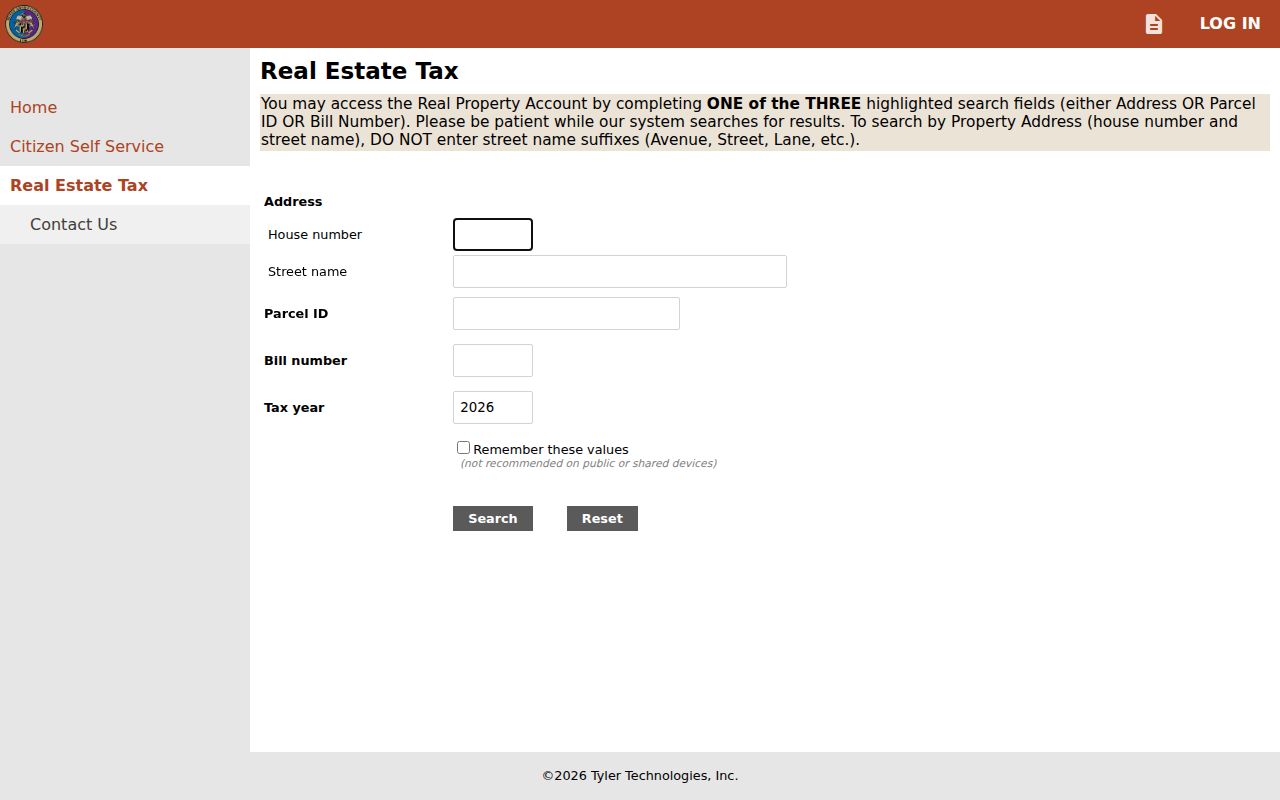
The official portal page displays the address, Parcel ID, Bill Number, and tax-year fields a visitor fills in to pull up a Queen Anne's County bill.
Queen Anne's Tax Rate and Fees
QAC Treasury sets the FY27 real-estate tax rate at $0.80 per $100 of assessed value. A bill is rarely that rate times the market value you see. Phase-in rules, credits, exemptions, and district charges all adjust the taxable record. Trust the bill itself for the final amount.
Payment channels carry their own costs. The county lists a 2.95 percent card fee with a $2.50 minimum. It also charges a $1.50 e-check fee. A daily transaction cap of $99,999 applies. Verify these on the Treasury property-tax page before you pay. They are convenience fees rather than property taxes.
Treasury sits at 107 North Liberty Street in Centreville, open 8:00 a.m. to 4:30 p.m. Call 410-758-0414 ext. 2087 with billing questions.
Queen Anne's Three-Year Reassessment
Maryland reassesses real property on a rotating three-year area cycle. The Queen Anne's County reassessment-area page names the county office handling each area. It also lays out the schedule. Every parcel has a date of finality that anchors the assessment under review. Hold onto that date whenever you compare years.
Comparison sales, land characteristics, and improvement facts should all come from the matching finality period. A deed recorded after the valuation date can explain why a recent sale and the current assessment disagree. Either record can still be right. For account-specific questions, visit the SDAT office at 120 Broadway, Suite 7.
Appeal a Queen Anne's Assessment
An appeal in Maryland starts with a deadline. You have 45 days from the assessment notice to file. The notice and control numbers on that letter feed the online appeal entry. Evidence matters most at every stage. Comparable sales near the valuation date carry weight. A factual correction to land or improvements also helps. Records showing a condition that affects value count too. The case can climb through the SDAT supervisor, the Property Tax Assessment Appeals Board, and the Maryland Tax Court. Each stage issues its own notice and filing instructions. One caution applies before filing. An ordinary disagreement with a tax bill is different from a dispute over the underlying assessment. Separate the two early. The state appeal form begins with two notice identifiers.
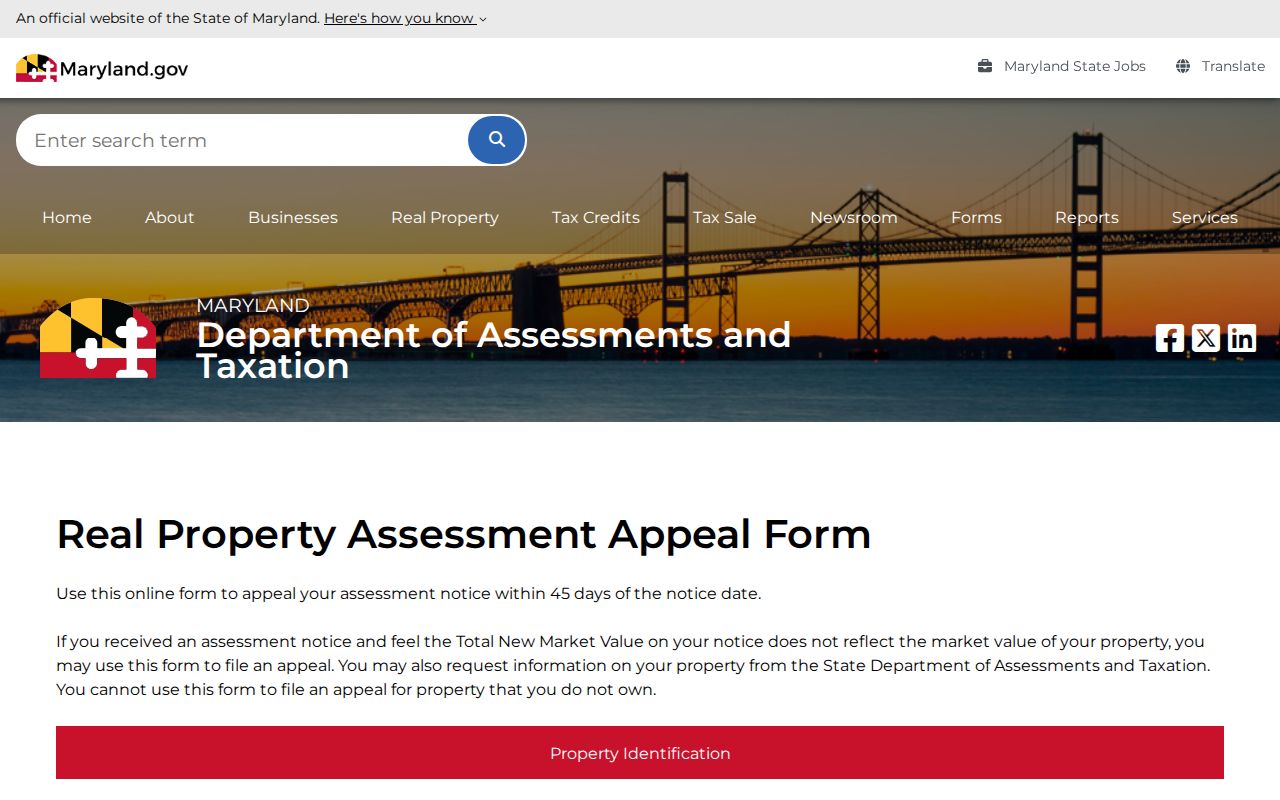
The form image shows why retaining the mailed assessment notice is essential.
Appeal window. File within 45 days of the assessment notice and follow the instructions on that notice. A late filing can forfeit the ordinary reassessment appeal route.
Credits and Exemption Fields
An SDAT record carries more than a value figure. Owner occupancy, principal-residence status, tax-exempt classification, and other account indicators appear in the fields. They help explain a Queen Anne's County property tax result. They never prove current eligibility. Every Maryland credit or exemption has its own application, deadlines, and proof rules, so keep the assessment notice and any approval or denial letter. Portals and bills sometimes disagree. Then ask SDAT about assessment status and Treasury about billing application, because the county collector generally cannot rewrite the state assessment record.
Delinquent Queen Anne's Tax Records
The annual tax sale runs entirely online. Queen Anne's County holds it on the third Tuesday in May. The next sale is May 18, 2027. The county publishes delinquent notices, final notice and advertising details, bidder preregistration, certificate rules, over-the-counter certificate information, and dated prior-sale PDFs. A listed certificate is a lien-stage record, not a deed conveying ordinary title. Past Tax Sale Results organizes the annual result files.
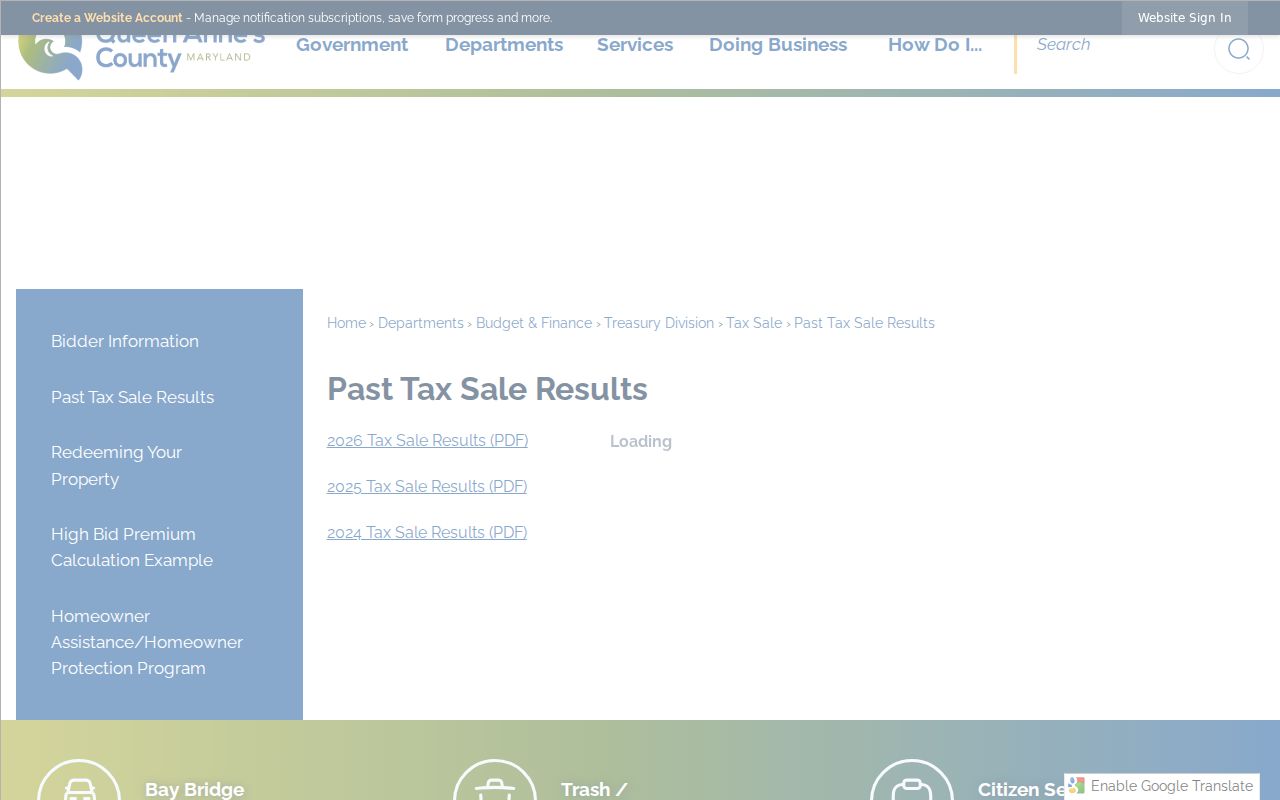
Save the result year and parcel address together. That pairing keeps a tax sale record findable later, since results are organized by sale year. Confirm redemption status with Treasury. Owners and buyers should also read the current county FAQ, because a search result can change after payment, redemption, court action, or a later deed.
Offline Queen Anne's Tax Help
Queen Anne's County splits its tax help across two offices. Assessment questions go to the SDAT Queen Anne's office. That covers property values, classification, credits, and appeals. Billing trouble belongs to QAC Treasury instead. Payments, delinquency, and tax-sale status all run through that office. Keep the channels separate. That keeps a payment dispute from being misread as an appeal on your Queen Anne's County property tax records.
Records that the county never posted online can still be requested under the Maryland Public Information Act. State assessment records stay with SDAT. So a PIA request to the county will not reach them. The Attorney General's PIA FAQ sets the ground rules: name the existing records you want. Agencies normally answer within 30 days. Reasonable costs may apply, and the first two search hours are free. No agency has to build a custom answer or create a new record for a request.