
Chart Queen Anne's Former Owners
Treat the backward deed chain as a working timeline. Each row is a real transfer. Every entry must come from an index or instrument you opened, starting with the current SDAT deed reference or the latest matching MDLandRec grantee result. Record the grantor, grantee, deed type, date, and liber or folio before stepping back another link.
| Transfer date | Grantor to grantee | Deed type | Book and page |
|---|---|---|---|
| Newest located recording | Current seller to buyer | As indexed | Copy exact liber and folio |
| Prior-reference date | Earlier seller to later seller | As stated in deed | Use “same property” reference |
| Next earlier recording | Repeat with prior grantee | As indexed | Check legal description |
| Archive-era entry | Names from historic index | Deed or other instrument | Order the book page |
Not every recorded paper conveys title. A mortgage release, easement, or court instrument can name the land without moving ownership, so count it as a transfer only when it conveys the interest at stake.
Start Queen Anne's Deed Chain
Maryland SDAT can supply the current deed reference after a search by premises address, account identifier, street, or map reference. Copy the Property ID, owner display, premises address, legal description, liber and folio, and sale date; those fields anchor the parcel. They skip its older owners.
Open the referenced image through MDLandRec. Transcribe the names, both dates, and any consideration. Add the land description and any prior book-page language. The same-land reference to an earlier instrument is the cleanest next step backward.
Reverse Queen Anne's Deed Index
MDLandRec offers deep filters. Party type, ownership, legal capacity, corporation name, document type, reference book and page, date range, and name fields can each narrow a search, and operators include exact, begins with, ends with, contains, fuzzy, and Soundex. Those tools rescue shifted spellings and stray initials.
- Open the newest matching purchase deed and identify its grantor, the party transferring the land.
- Follow the deed's prior book and page. If none appears, search that grantor as an earlier grantee.
- Compare the legal description, parcel references, consideration, and place before accepting the match.
- Repeat until the online trail ends, then carry the last reliable names and reference to the Clerk or Archives.
- Grantor
- The party transferring the stated interest.
- Grantee
- The party receiving that interest.
- Chain of title
- The linked sequence of instruments affecting ownership of the same land.
- Reverse index
- An index used to find prior links through the conveying party's name.
- Warranty and quitclaim deeds
- Different conveyance forms whose exact rights and promises must be read in the instrument.
Queen Anne's Indexes Reach 1707
Queen Anne's County was created in 1706. Maryland State Archives land series begin around 1707. C1426 holds land and chattel records from 1707 through 1851, covering deeds, releases, leases, assignments, agreements, easements, and mortgages. C1428 and C1430 cover grantee and grantor routes. Later series continue the trail.
The historic Queen Anne's grantor index alphabetizes names and orders entries by date, with grantee, instrument type, and book-page details on the official page.
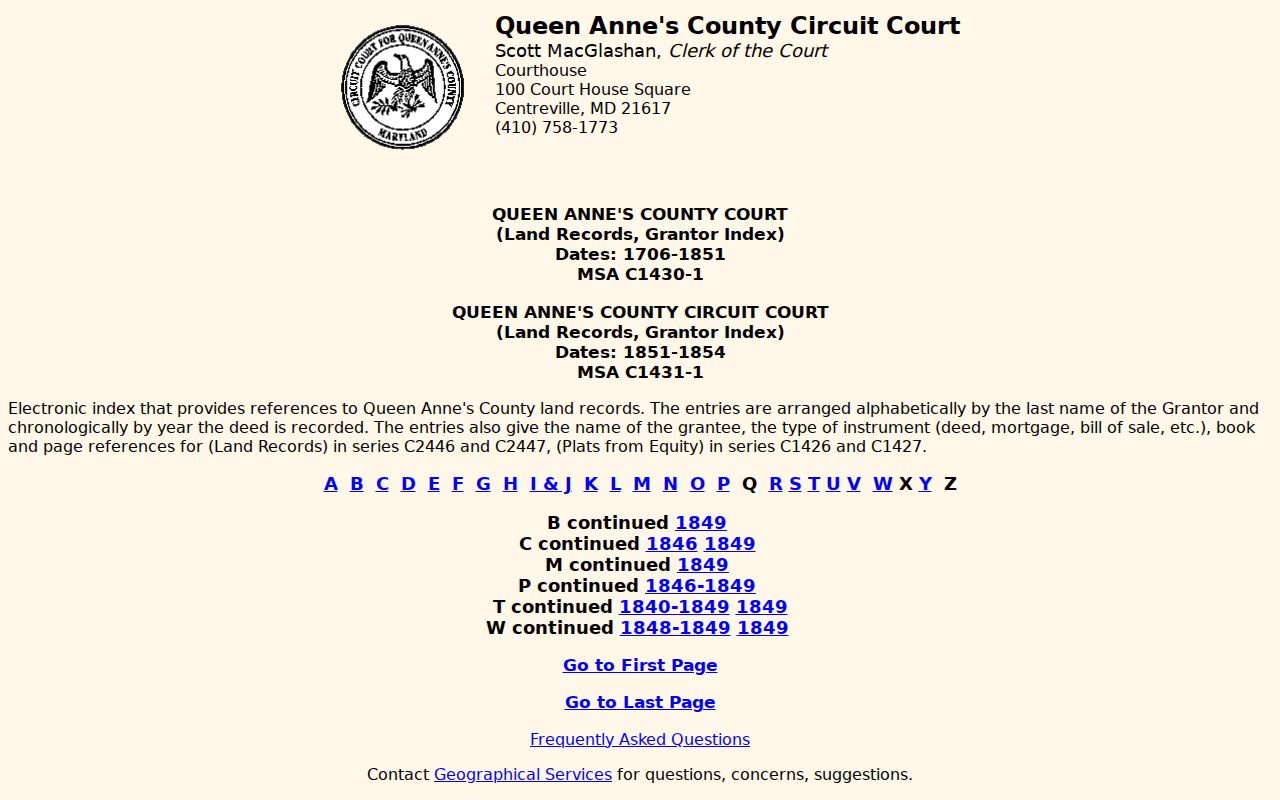
The index names the volume, but the deed itself must confirm the transfer.
Queen Anne's Pre-1981 Release Gap
One snag is unique to this county. Short-form releases recorded before July 1, 1981 are not indexed through Queen Anne's County's short-form release route, so local instructions point researchers back to the SDAT deed reference, MDLandRec, the Clerk, or Maryland State Archives. The workaround takes extra steps.
Online cutoff is not known. Historic series reach 1707, but the exact modern MDLandRec start year was not located. Use paper, microfilm, Clerk, and Archives channels when the portal trail stops.
A missing online release or deed is only a gap. It is not proof that the event never occurred.
Plats Track Queen Anne's Old Lots
Addresses drift over time. Lots get split or renumbered, and a subdivision may be recorded after an older metes-and-bounds deed. Maryland Plats.net supplies subdivision images, and the Archives inventory includes S1251 material from 1946 plus T1913 plats from 2006 through 2025.
Compare title, section, block, lot, streets, and open space. One current parcel may hide several predecessor tracts. The plat explains geometry, but it does not name every former owner.
Estate Transfers in Queen Anne's
A death can interrupt a simple chain. The next transfer may appear under an estate, trustee, personal representative, or another legal capacity. Search both the decedent and representative names. Then read the deed itself instead of treating a probate mention as a conveyance.
Queen Anne's County offers no active online probate search, so wills, accounts, inventories, and death-transfer context fall back to the Circuit Clerk, Archives guides, and Queen Anne's County Library research resources. Vital-record restrictions still apply.
Queenstown and Centre Ville Records
A courthouse stood at Queenstown in 1708. The Assembly moved the county seat to central Centre Ville in 1782. Construction followed in the 1790s. Older deeds may lean on tract, road, neighbor, or place descriptions that no modern address matches.
Keep the original wording. Search old party names and book references. Newspapers may add occupancy or sale context, but they cannot establish ownership without a recorded transfer.
Depth of Queen Anne's Owner Records
A documented chain can reach the colonial record era around 1707, but never through one web search. Maryland State Archives paper, electronic, and microfilm series overlap. No courthouse fire disrupted Queen Anne's land books. The exact modern imaging cutoff stays unknown.
When a chain breaks, record the last verified deed, names searched, spelling variants, date span, legal description, and the next repository. The Circuit Court Clerk Land Records counter at 200 North Commerce Street in Centreville offers weekday access. Archives search-room and mail-order routes add older coverage.
Respect living people. Previous-owner research supports house history, estate work, and purchase diligence. Never use the trail to stalk, harass, or harm anyone.
A solid chain log pairs every former owner with the exact deed behind the name. It also flags rejected same-name matches, relabeled lots, and gaps that never resolved. Queen Anne's County makes that discipline necessary. Historic place terms, modern tax identifiers, and recorded book-page references each live in a different system. Names can drift between them. Done well, the log yields a defensible sequence of previous owners. Uncertainty stays visible rather than buried. For detail on a single instrument, the Queen Anne's County deed records route is the right tool. This timeline stays focused on prior owners and their linked transfers.